Billy Quigley
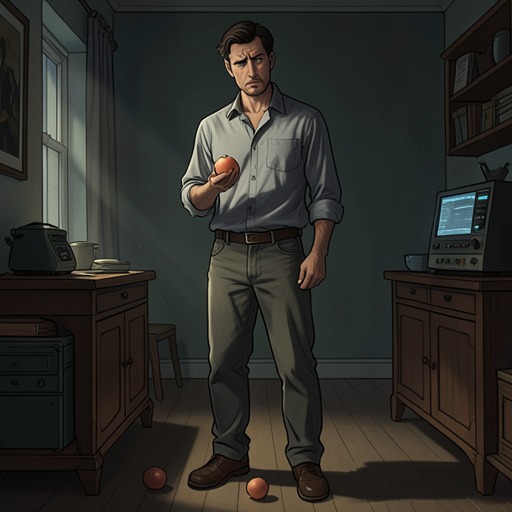
Straight ManBilly Quigley is an English professor nearing the end of a long, financially burdened career, a heavy drinker, and one of William Henry Devereaux, Jr.’s most quarrelsome friends. His calls to William Henry Devereaux, Jr. turn departmental anxiety into personal accusation, but their recurring pattern of insult, vulnerability, and reconciliation also reveals a loyalty that neither man expresses easily. Billy’s devotion to his children, his concern for daughter Meg’s prospects, and a novel he has kept to himself complicate the exhausted, combative figure he presents to colleagues.
Identity and Background
Billy is fifty-seven, Irish and Catholic, and worn down by a career that still has eight years to run before retirement. He and his wife, a local woman he married young, live in the same shabby house he bought about thirty years earlier, before the neighborhood deteriorated. The mortgage is only $150 a month, but that modest payment does little to ease the family’s wider financial pressures: Billy’s salary goes toward loans accumulated while he taught summer sessions and took course overloads during regular semesters.
Those extra classes helped him put ten children through private parochial schools and expensive Catholic colleges. His youngest daughter, Colleen, has been accepted to Notre Dame on a music scholarship that covers only part of the cost, and Billy intends to pay the rest. The sacrifice behind that commitment gives his drinking and weariness a material context. He is not simply a professor who has lost interest in work; he is a father who has spent years extending his labor to meet his family’s needs, while the prospect of eight more years on the job feels to him like an eternity.
A Friendship Built on Insult and Forgiveness
Billy periodically phones William Henry Devereaux, Jr. to berate him, insult him, and then ask forgiveness. He begins one call by accusing him of having known Billy was at home, though William Henry Devereaux, Jr. has only just walked in; when asked how drunk he is, Billy admits that he is very drunk and insists the matter is private. The routine has recognizable stages. Billy vents, the two trade barbs, and the call gradually winds down. William Henry Devereaux, Jr. says he likes Billy and does not blame him for drinking himself into oblivion; despite the abuse, he habitually forgives him.
The impending faculty purge gives these calls their political charge. Billy fears that William Henry Devereaux, Jr. is drawing up a list of colleagues to dismiss and accuses him of being a sellout who would sacrifice them for money. William Henry Devereaux, Jr. answers with a joke about getting full price rather than selling the department cheaply. Billy’s anger is genuine, but humor often helps it burn out. William Henry Devereaux, Jr. sees the joke as a way to play along until Billy comes around; Lily, by contrast, considers his habit of turning accusations into a running gag evidence that he treats everything as a joke. The exception to this comic détente is Paul Rourke, who has vowed never to laugh at him.
Billy can also recognize when his anger has crossed a line. After urging William Henry Devereaux, Jr. to send his own children to school, he asks why he is allowed to speak so abusively instead of having the phone hung up on him. William Henry Devereaux, Jr. says he does not know, while also asking Billy not to bring up his children. Billy admits that he should not have done so and says that at times he feels he is going to explode. The moment makes visible the hurt and shame underneath his aggression without erasing the harm his words can cause.
Meg and Billy’s Private Literary Ambition
Billy’s protectiveness toward Meg surfaces in a sober, deliberate request. When he catches William Henry Devereaux, Jr. trying to pass his open office door, he brings him inside, drinks a short measure of Irish whiskey, and asks him not to rehire Meg for the fall. He has spoken with a contact at Marquette who can arrange an assistantship for her. Billy believes she has the best prospects among his children and wants her to take that opportunity, even though asking William Henry Devereaux, Jr. to remove her from her current position is a difficult favor. His request shows him using his knowledge of academic connections to make a path for his daughter, rather than merely trying to shield her from hardship.
Meg later tells William Henry Devereaux, Jr. that her father once wanted to be a writer and wrote a novel. The revelation changes how he sees Billy: most of the English department’s faculty, he observes, have half-finished novels, and colleagues had previously pressed their manuscripts on him to read, but Billy had never asked him to read his. William Henry Devereaux, Jr. admires that Billy wrote a novel and kept it private. When William Henry Devereaux, Sr.’s papers are later being sorted, his mother discovers a two-hundred-page manuscript novel from nearly twenty-five years earlier and expects her son to read it. He explains that colleagues had already shown it to him, then says he would have preferred to read Billy’s book. The comparison underscores the distinction he draws between a manuscript circulated for approval and Billy’s unadvertised act of making one.
Billy’s anxiety about the purge returns in his voicemail to William Henry Devereaux, Jr., which consists entirely of the accusation Judas Peckerwood. Later, Meg herself challenges William Henry Devereaux, Jr. about whether her father is on his list and asks whether he knew Billy once wanted to be a writer. The repeated accusation links the professional threat to a more personal question: whether William Henry Devereaux, Jr. will treat Billy as a colleague to be sacrificed or as a man whose exhaustion and unrealized ambition he understands.
Department Politics and the Recall Vote
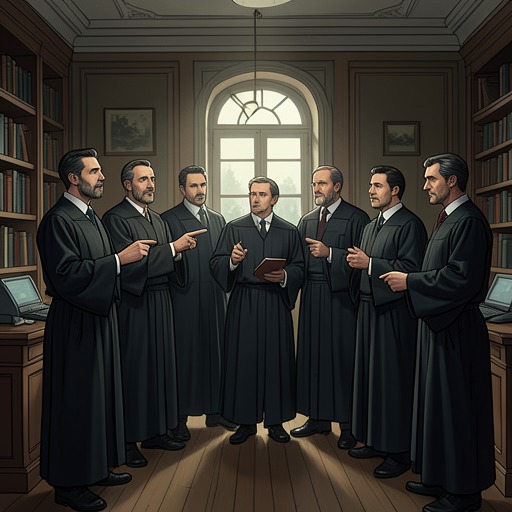
Billy’s impatience becomes explicit during the meeting to recall William Henry Devereaux, Jr. as department chair. While William Henry Devereaux, Jr. is concealed above the ceiling and listening, Billy urges the department to vote and go home. Finny objects that Billy was not present for the discussion; Billy counters that he has been listening to his colleagues for thirty years. His reply invokes experience as a claim to standing, even when he has arrived late and is not following the meeting’s procedure closely.
When the ballot is explained, Billy initially marks the option supporting recall, apparently misunderstanding what the yes vote means. June takes the ballot and changes it to a vote against recall after Billy protests that he is for William Henry Devereaux, Jr. The episode is both comic and revealing: Billy’s declared support is real, but the formal process is confusing to him, and another colleague has to translate his intention into the correct vote. The department recalls William Henry Devereaux, Jr. by the required two-thirds majority, with eighteen votes for recall and nine against. Billy’s support does not decide the outcome, but it confirms that his recurring attacks have not made him an enemy of his friend.
Afterward, Billy raises with Jacob Rose the report that Gracie is telling people she and Jacob are getting married. Jacob replies that he had asked William Henry Devereaux, Jr. to be best man, though the chair’s apparent disappearance gives him reason to reconsider. Billy’s question places him among the colleagues attending to personal news even amid institutional upheaval. Later, when William Henry Devereaux, Jr. asks about Billy’s future, Jacob explains that Walter is retiring from university publications and Billy will be offered his job. Billy has wanted the position for a long time; Jacob adds that it will allow him to drink privately during the day. The planned move offers him an alternative to the teaching role that has exhausted him, though the account does not establish what he ultimately does with the offer.
Character and Narrative Significance
Billy’s characterization rests on a continuing contradiction: he can be cruel in his drunken calls and tenderly attentive to his children; he fears that colleagues will be discarded, yet he has written a novel without seeking recognition for it. His drinking is neither excused nor presented in isolation. The novel places it beside the years of extra teaching, the loans, the looming retirement, and his repeated efforts to secure educational opportunities for his children. His confession that he sometimes feels ready to explode gives the anger a human source, while his apology for bringing up William Henry Devereaux, Jr.’s children shows that he remains capable of seeing the boundary he has crossed.
The recurring epithet Judas Peckerwood turns Billy’s fear of betrayal into a comic refrain, but the underlying question is serious: what does loyalty mean when a department is asked to judge its own members under threat of cuts? Billy is not a reliable guide to the meeting’s procedures, nor does his support save William Henry Devereaux, Jr.’s chair. Still, his vote and his continued friendship prevent the insults from being read as simple enmity. In the closing gathering at Tony Coniglia’s home, Billy has cornered the new dean and is giving him the same drunken riot act, with the familiar insult audible again. The scene suggests that his irreverent, aggrieved manner persists even as university positions change around him.